
Wall Street Records, Iran Updates, and Tesla Q1 Earnings: What to Watch
 Jurnalis di Nalar
April 19, 2026 16:32
.
8 min read
Jurnalis di Nalar
April 19, 2026 16:32
.
8 min read
In spite of — and maybe due to — a week of fluctuating headlines regarding peace negotiations with Iran, two of three major indices surged to new all-time records as all three finished their third consecutive week of profits.
The S&P 500 (^GSPC) ended Friday up 1.2% with a gain of 4.5% for the week, while the tech-heavy Nasdaq (^IXIC) concluded Friday up 1.5% for a 6.8% yield across the five-day period.
The Dow (^DJI), the sole major index to not breach its all-time peak last week, finished Friday up 1.8%, or roughly 850 points, to close the week up 3.2%.
A busy earnings schedule — but a quiet economic data calendar — will welcome investors in the upcoming week.
Retail sales figures on Tuesday and reports on consumer sentiment from the University of Michigan on Friday will headline the week’s economic data drops. Both metrics are projected to offer investors a gauge on the health of the consumer eight weeks into a conflict that has strained the global economy, hiked prices, and elevated uncertainty.
Since the University of Michigan’s consumer sentiment poll plunged to a historic low of 47.6 in the April preliminary report issued earlier this month, the metric will be closely monitored.
Results on Wednesday from Elon Musk’s Tesla (TSLA) and on Thursday from semiconductor titan Intel Corporation (INTC), which surged to its highest intraday level since 2000 on Friday, spotlight a packed week of financial reports.
Updates from Alaska Air Group (ALK) on Monday and United Airlines (UAL) on Tuesday will deliver another gauge on the impact of surging jet fuel expenses, whereas GE Vernova’s (GEV) figures on Wednesday will serve as an indicator for the health of AI and power grid infrastructure demand.
Wall Street’s ‘Offense is Taking the Field’
Even as a provisional truce between the US and Iran appears to be holding prior to its deadline on Tuesday, there remains no clear conclusion in sight for the conflict that has disrupted global energy supplies.
The US stock market remains unfazed, as the all-time records demonstrate.
“Offense is taking the field. Risk appetite has returned, and early cyclical rotation pressures are building beneath the surface of the broader market,” stated LPL Financial chief technical strategist Adam Turnquist.
However, strategists caution that although there has been a widespread revival of equity momentum, markets will require tangible progress in Iran to sustain it. On Friday, Iran’s foreign minister Abbas Aragchi noted the Strait of Hormuz was “fully open,” yet vessel movement remained mostly halted.
“Very soon … continued support for the rally may have to come from signs of actual concessions, either from the US’s side or from Iran,” Macquarie strategist Thierry Wizman explained.
The Big Tech motor that drove the stock market throughout the last decade has returned.
After dropping to its lowest point since July 2025 during the initial six weeks of the conflict in Iran, an ETF following the Magnificent Seven stocks (MAGS) has gained 9% over the last five sessions to near its all-time peak.
This tech resurgence is not baseless, HSBC head of Americas equity strategy Nicole Inui mentioned in a client memo on Thursday. Shareholders should anticipate a “banner Q1 earnings season despite heightened market uncertainty,” with the highest optimism surrounding tech.
The Magnificent Seven equities are projected to yield 20% expansion in profits compared to 12% growth among the 493 remaining constituents that comprise the S&P 500.
In a further display of resilience, Taiwan Semiconductor Manufacturing Company (TSM) on Thursday robustly beat Q1 forecasts, reporting year-over-year surges in adjusted EPS and sales of 66% and 40%, respectively.
Yet, as the Wall Street adage goes, previous performance does not guarantee future outcomes. The technology sector could be “very near the end of this rally,” according to Jefferies’ Michael Toomey.
“While I think much of the normalization that we’ve seen is fundamentally healthy for the market, I think we have captured the rally (and then some),” Toomey expressed. “So tactically, I think we will consolidate in the near-term.”
Even With Open Waters, the Strait of Hormuz Needs Time
Within the Middle East, the week delivered a flood of positive news for a market desperate for resolution, and crude prices dropped in response.
On Friday, Iran’s foreign minister Abbas Aragchi stated the Strait of Hormuz, the globe’s most vital maritime chokepoint for petroleum, was “fully open” to commercial transit. A few hours afterward, President Trump stated Iran had agreed to permanently halt its nuclear enrichment operations, that Iran had pledged to never again blockade the strait, and that both parties would convene this weekend for a second phase of discussions.
Crude oil dropped to levels absent since the initial days of the conflict.
“Any credible signal that the [Strait of Hormuz] may reopen, even temporarily, is a market-moving development of the first order,” Artam Abramov, deputy head of analysis at Rystad Energy, mentioned in a client memo on Friday.
Nevertheless, even if the US and Iran were to execute a final, binding peace treaty this week and the Strait of Hormuz were to be unblocked, specialists warn that the oil sector might still require weeks or months to stabilize.
There remain hundreds of vessels trapped in the Persian Gulf, and Middle Eastern crude output has been slashed by roughly 12.4 million barrels daily, according to Rystad, which will require time to resume.
The market pivoted regardless.
“Today’s announcement has materially shifted the probability distribution of outcomes,” Abramov noted. “The market is not waiting for a formal deal — it is pricing in the possibility of one.”
Tesla Stock Remains Driven by Market Sentiment and Faith
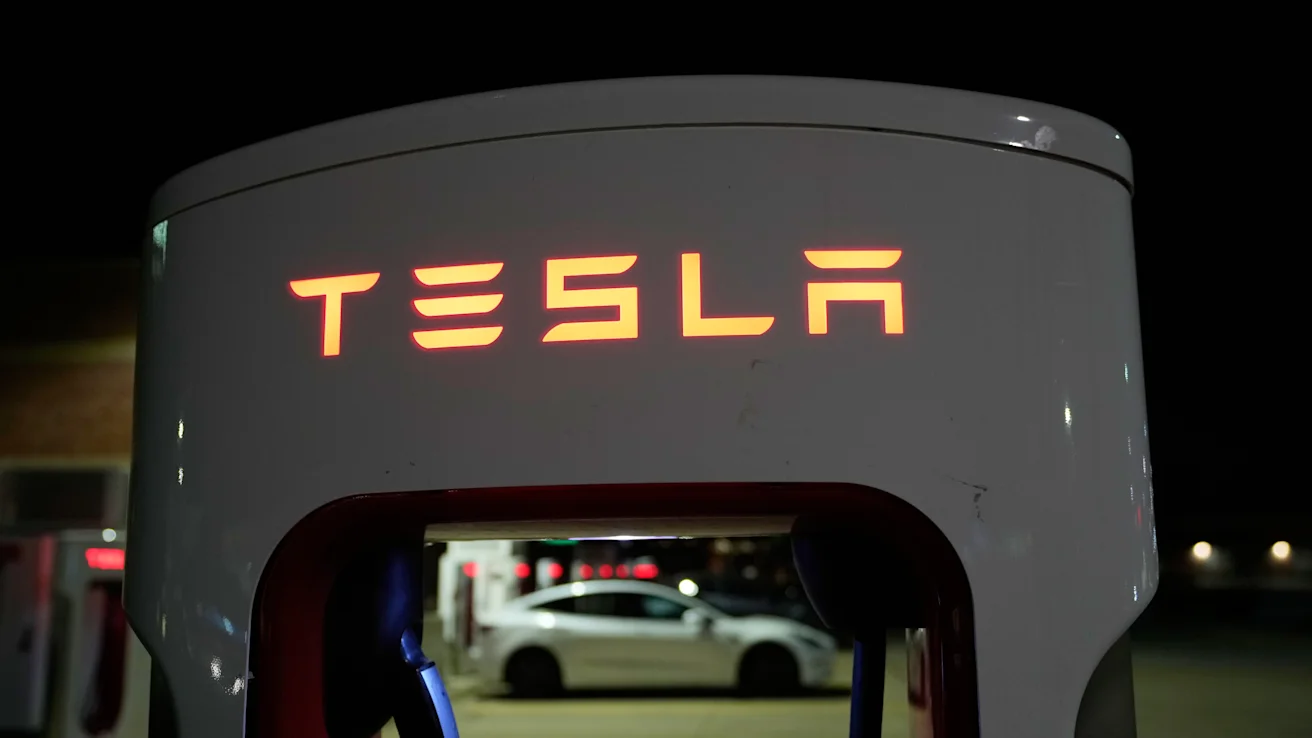
Tesla will kick off Big Tech’s Q1 reports on Wednesday in one of the premier events of the week for shareholders after successfully breaking an eight-week downward streak on Friday.
Of particular interest to investors will be developments from the hybrid automaker and robotics firm regarding its semiconductor ambitions.
CEO Elon Musk noted on Wednesday that Tesla was in the concluding design phases of its AI5 chip, engineered for upcoming EVs, massive training clusters, and Optimus robots, while Reuters reported the firm was seeking to recruit chip engineers in Taiwan, where Taiwan Semiconductor Manufacturing Company manufactures its hardware.
Although Tesla has presented plans to produce its own processors internally at its forthcoming Terafab complex, analysts and industry professionals suggest that Tesla building its own foundry would be an immense engineering challenge.
All of this feeds into the debate of whether Tesla, primarily an electric-vehicle maker, can persuade shareholders it can become a dominant force in robotics and AI.
As UBS’ Joseph Spak highlights, the “stock trades more on sentiment, narrative and momentum than fundamentals.” Approaching Q1 earnings, Spak detailed in a recent memo, Tesla will have multiple obstacles to overcome, but that does not mean the firm’s automation vision lacks mechanical legs.
“Recent concerns over EV demand, a 1Q26 energy shortfall, higher costs, higher capital spending requirements, and slow progress of robo-taxi and Optimus have weighed on stock, in our view,” Spak observed. “However, we do expect eventual progress on robo-taxi and Optimus and continue to view TSLA as a leader in physical AI.”
Weekly Economic Data and Corporate Earnings Calendar
Monday
- Economic reports: No notable economic data.
- Earnings schedule: Steel Dynamics (STLD), AGNC Investment Corp. (AGNC), Wintrust Financial Corporation (WTFC), Cleveland-Cliffs (CLF), Alaska Air Group (ALK), Bank of Hawaii (BOH), Dynex Capital (DX)
Tuesday
- Economic reports: ADP weekly employment change, week ended April 4 (39,250 previously); Philadelphia Fed non-manufacturing activity, April (-23.9 previously); Retail sales advance, month-on-month, March (+1.3% expected, +0.6% previously); Retail sales ex auto, month-on-month, March (+1.3% expected, +0.5% previously); Retail sales ex auto and gas, March (+0.2% expected, +0.4% previously); Business inventories, February (+0.3% expected, -0.1% previously)
- Earnings schedule: GE Aerospace (GE), UnitedHealth Group (UNH), RTX Corporation (RTX), Intuitive Surgical (ISRG), Danaher Corporation (DHR), Interactive Brokers (IBKR), Chubb (CB), Capital One (COF), Northrop Grumman (NOC), 3M (MMM), ASM International NV (ASMIY), MSCI (MSCI), EQT (EQT), Halliburton (HAL), United Airlines (UAL), Northern Trust (NTRS), Synchrony Financial (SYF), Tractor Supply Company (TSCO), Equifax (EFX)
Wednesday
- Economic reports: MBA mortgage applications, week ended April 17 (+1.8% previously)
- Earnings schedule: Tesla (TSLA), Lam Research (LRCX), GE Vernova (GEV), Philip Morris (PM), IBM (IBM), Texas Instruments (TXN), AT&T (T), Boeing (BA), Verity Holdings (VRT), CME Group (CME), ServiceNow (NOW), Boston Scientific (BSX), Moody’s Corporation (MCO), CSX Corporation (CSX), Kinder Morgan (KMI), Elevance Health (ELV), TE Connectivity (TEL), United Rentals (URI), Westinghouse (WAB), Waste Connections (WCN), Las Vegas Sands Corp. (LVS), Otis Worldwide Corporation (OTIS), Raymond James Financial (RJF)
Thursday
- Economic reports: Chicago Fed national activity index, March (-0.11 previously); Initial jobless claims, week ended April 18 (+210,000 expected, +207,000 previously); Continuing claims, week ended April 11 (1.82 million previously); S&P Global US manufacturing PMI, April preliminary reading (52.8 expected, 52.3 previously); S&P Global US services PMI, April preliminary reading (50 expected, 49.8 previously); S&P Global US composite PMI, April preliminary reading (50.3 previously); Kansas City Fed manufacturing activity, April (11 previously)
- Earnings schedule: Intel (INTC), American Express (AXP), SAP (SAP), Thermo Fisher Scientific (TMO), NextEra Energy (NEE), Gilead Sciences (GILD), Blackstone (BX), Southern Copper (SCCO), Union Pacific (UNP), Honeywell International (HON), Lockheed Martin (LMT), Newmont (NEM), Sanofi (SNY), Comcast (CMCSA), Freeport-McMoran (FCX), Vale S.A. (VALE), Digital Realty Trust (DLR), Baker Hughes (BKR), Infosys (INFY), Nasdaq, Inc (NDAQ), CBRE Group (CBRE)
Friday
- Economic reports: University of Michigan sentiment, April final reading (48.3 expected, 47.6 previously); U. Mich. current conditions, April final reading (50.1 previously); U. Mich. expectations, April final reading (46.1 previously); U. Mich. 1-year inflation, April final reading (+4.8% previously); U. Mich. 5-10 year inflation, April final reading (+3.4% previously); Kansas City Fed services activity, April (15 previously)
- Earnings schedule: Proctor & Gamble (PG), HCA Healthcare (HCA), Eni S.p.A. (E), SLB (SLB), Norfolk Southern (NSC), Charter Communications (CHTR), Nomura Holdings (NMR), Flagstar Bank (FLG)